
engineering
How ClawTeams Designs Reliable AI Employee Workflows
Engineering principles for controlled agentic work, visible progress, human approval, and safe product boundaries.
Reliable AI agents are not created by giving a model more freedom. They are created by giving AI work the right structure.
For business teams, reliability means more than whether an agent can complete one impressive demo. It means the workflow is understandable, controllable, repeatable, and recoverable when the situation changes.
That is the engineering philosophy behind ClawTeams: AI employees should work inside clear roles, visible state, approved boundaries, and human-controlled operating rhythms.
The short answer
ClawTeams designs reliable AI employee workflows by separating responsibilities, keeping goals and todos visible, controlling important actions, supporting recurring execution, and treating human approval as part of the system rather than an afterthought.
What reliability means for AI employee workflows
In normal software, reliability often means uptime, latency, data correctness, and fault recovery. Those still matter. But AI employee workflows add a different reliability problem: judgment and action happen across changing context.
A reliable workflow should answer basic questions:
- What goal is the AI team working toward?
- Which AI employee owns this task?
- What context is being used?
- What action was taken or proposed?
- What still needs human approval?
- What should happen next?
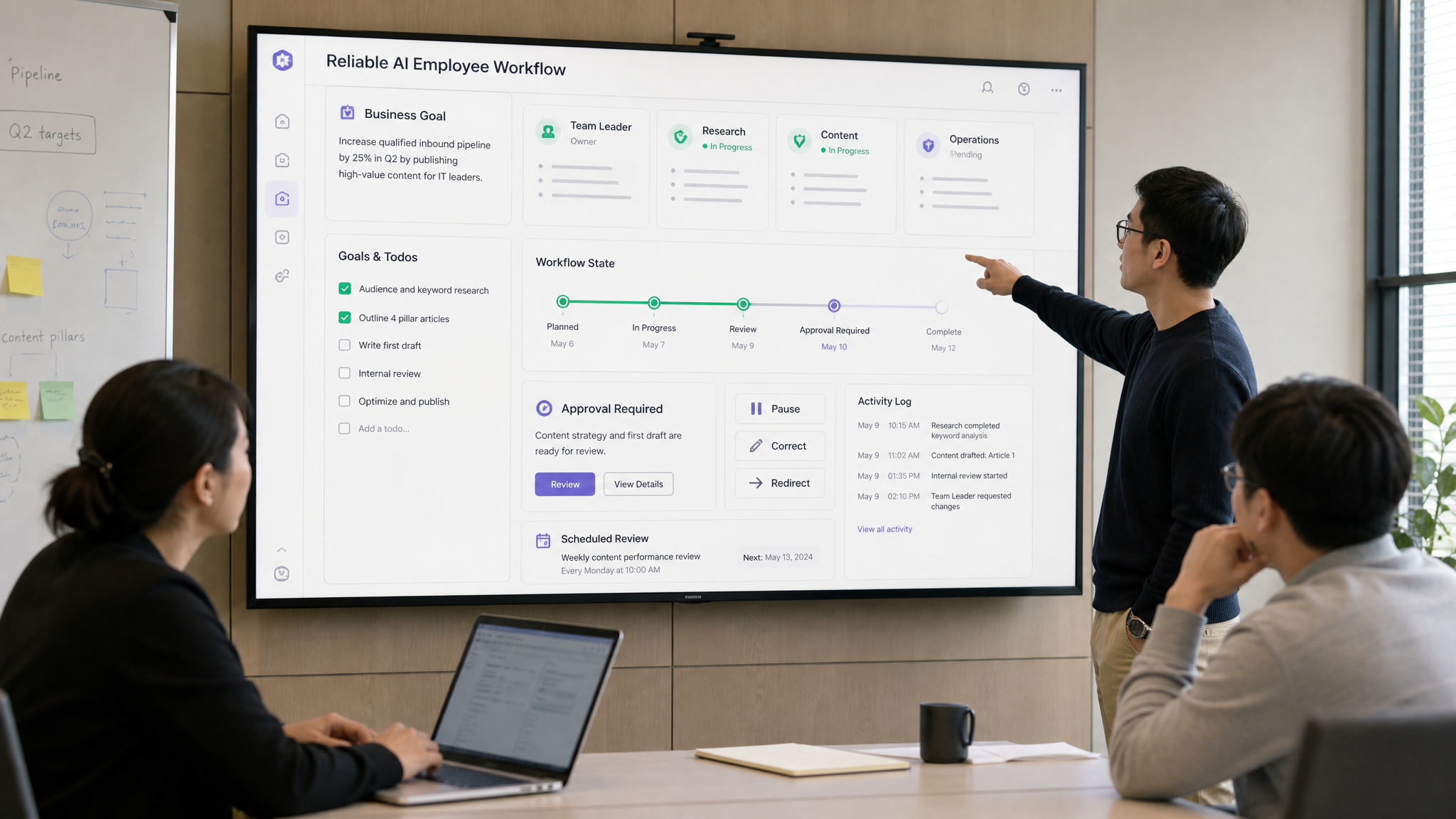
- How can the operator pause, correct, or redirect the workflow?
If these questions are hard to answer, the workflow may look autonomous but feel risky to operate.
Principle 1: scope the role before expanding autonomy
Autonomous AI agents can sound attractive, but broad autonomy is rarely the right starting point for business work.
ClawTeams starts from role clarity. A specialist AI employee should know what it is responsible for, what it should not decide alone, and when to return work to the AI Team Leader or the human operator.
This role structure helps in three ways:
- It makes outputs easier to review.
- It reduces responsibility overlap between agents.
- It gives humans a clearer way to change the workflow.
The practical goal is not maximum autonomy. The goal is useful autonomy within a business-safe scope.
Principle 2: make workflow state visible
AI work becomes hard to trust when state is hidden inside a long conversation.
ClawTeams uses product surfaces such as Goals & Todos to keep the workflow understandable. A goal gives direction. Todos show what needs to happen. Updates and decisions help the team see where the work stands.
Visible state turns AI from a black-box assistant into something closer to an operating system for delegated work.
This is especially important for recurring workflows. When a meeting, scheduled task, or follow-up happens later, the AI team should not have to rebuild the entire context from memory or ask the human to repeat everything.
Principle 3: separate creation from approval
Generative AI is good at producing options. Agentic AI can take steps toward a result. Business teams still need control over consequential actions.
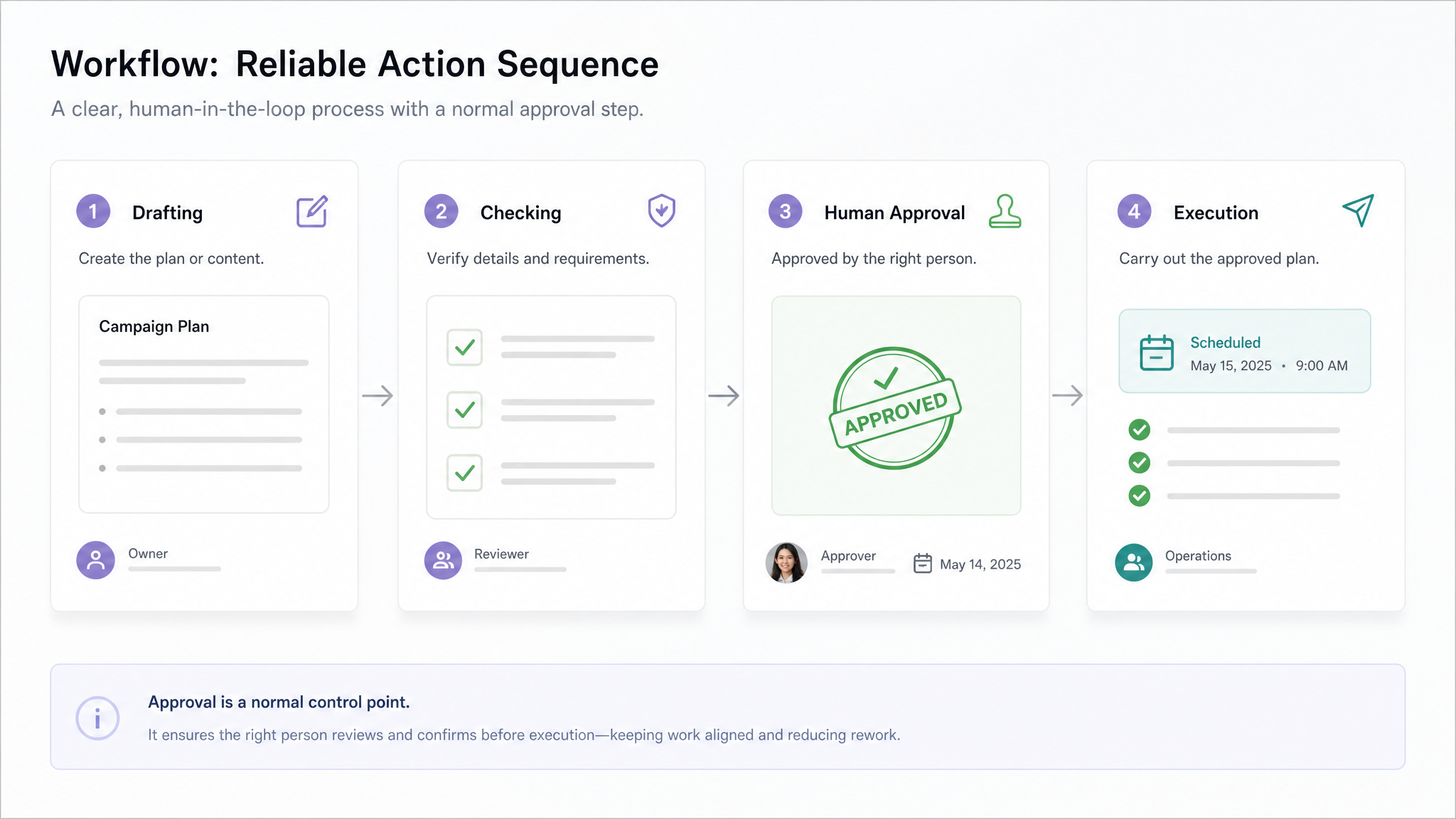
That is why reliable AI agents should separate:
- Drafting: preparing an output or recommendation.
- Checking: reviewing quality, consistency, and missing context.
- Approval: asking a human before an important action.
- Execution: moving forward inside the approved boundary.
This structure keeps AI useful without pretending that every decision should be automated.
For ClawTeams, human approval is not a sign that the agent failed. It is a normal control point in the workflow.
Principle 4: coordinate through the way teams already work
Business teams do not only work inside dashboards. They work through messages, updates, requests, reminders, and reviews.
A reliable AI agent platform should respect that operating pattern. It should support workplace coordination, not force every decision into an isolated tool.
ClawTeams is designed around workplace messaging patterns so that delegation and updates can happen close to where teams already communicate. The AI Team Leader can coordinate specialist work, while humans can still review direction and decisions in a familiar flow.
Reliability improves when the product meets the team where coordination already happens.
Principle 5: build for recurring execution, not one-time output
Many AI demos stop after one output. Business work does not.
A customer support quality review may happen every week. A market scan may run every morning. A launch plan may require several checkpoints. A campaign may need review after each result.
Meetings and Scheduled Tasks help ClawTeams support this recurring rhythm. They give the AI team a way to continue work, surface progress, and turn previous outputs into the next step.
This is where agentic AI frameworks often become product questions. The framework may define planning or tool use, but the business product must also define cadence, visibility, approval, and recovery.
What is OpenClaw at a high level?
OpenClaw can be described as part of the runtime foundation behind ClawTeams. In public terms, that means it supports the environment where AI work can be executed, coordinated, and connected to product-level controls.
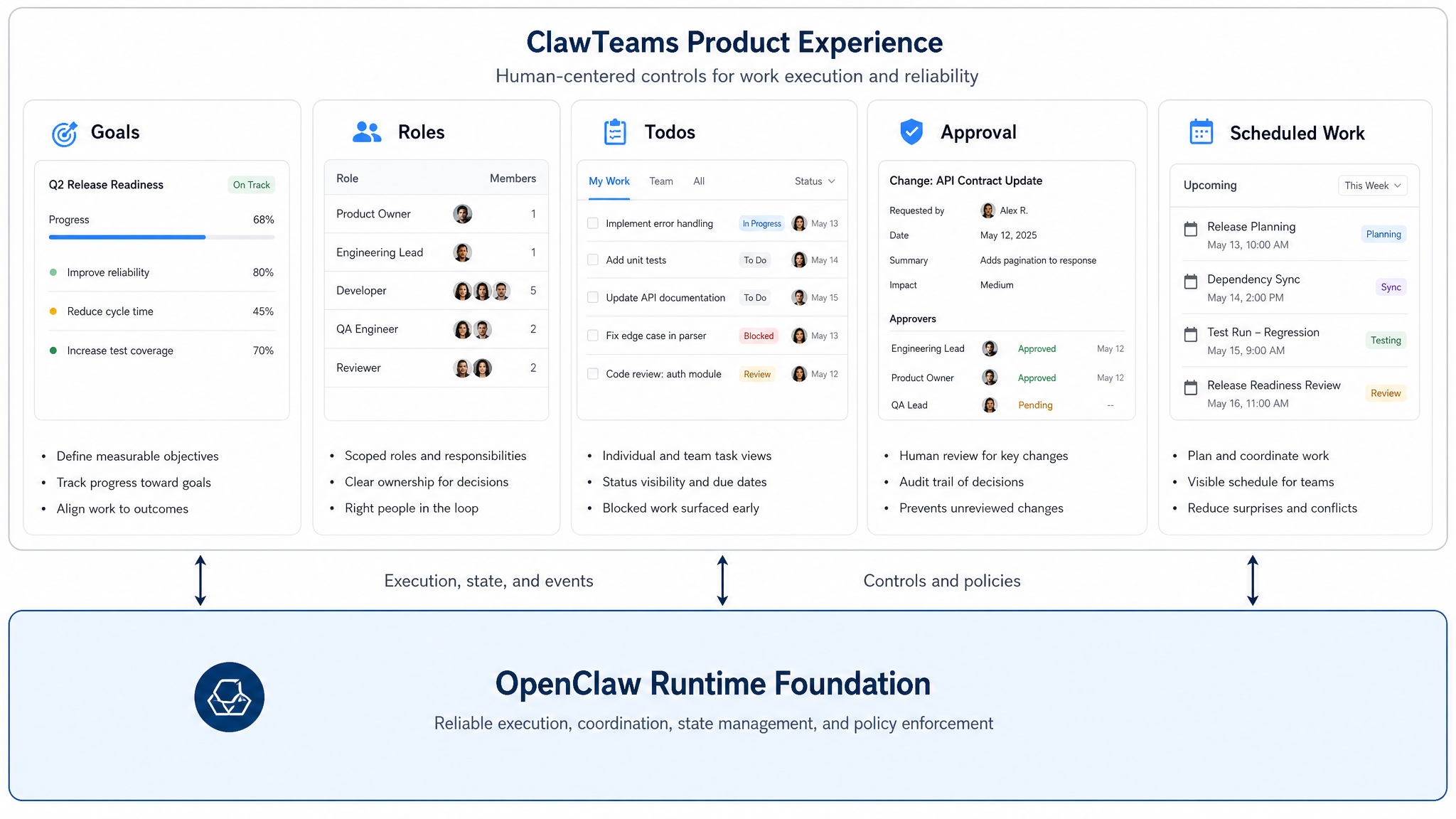
For readers asking what is OpenClaw or what is OpenClaw AI, the simple answer is that OpenClaw belongs in the runtime layer discussion. ClawTeams is the business-facing product experience built around goals, roles, workflows, and human control.
For this article, the important point is not an internal architecture diagram. It is the product principle:
Reliable AI work needs a runtime foundation, but the user experience should expose goals, roles, progress, approval, and control rather than infrastructure details.
For readers searching for an OpenClaw AI agent explanation, the safest public framing is this: OpenClaw AI agent work should be understood through the lens of runtime foundation and product controls, not as a standalone promise of unlimited autonomy.
ClawTeams keeps the customer-facing experience focused on business workflow. The engineering layer should support that experience without forcing operators to think about low-level technical machinery.
How to evaluate reliable AI agents for business
If you are choosing an AI agent platform, do not evaluate reliability only by how advanced the model sounds. Evaluate the operating surface.
Ask these questions:
- Can the platform turn a goal into role-based work?
- Can you see the current goal, task list, and owner?
- Can important actions require human approval?
- Can the workflow continue through meetings or scheduled tasks?
- Can a human pause, correct, or redirect the process?
- Are responsibilities separated enough to review outputs clearly?
- Does the product avoid exposing unnecessary technical complexity to business users?
The best reliable AI agents are not the most mysterious. They are the ones teams can understand, control, and improve over time.
Conclusion
Reliability in AI employee workflows is a product and engineering discipline.
ClawTeams is designed around the idea that AI work should be delegated, visible, recurring, and controlled. The AI Team Leader coordinates. Specialist AI employees execute within defined roles. Humans keep the authority to approve, redirect, and judge important outcomes.
That is the kind of reliability business teams need before they can trust agentic systems with real work.
Explore the ClawTeams product model.
Related ClawTeams resources
- ClawTeams product overview: see how goals, specialist AI employees, meetings, scheduled tasks, and human approval fit together.
- Build your AI team: start from a business goal and assemble the specialist roles you need.
Frequently asked questions
What are reliable AI agents?
Reliable AI agents are agents that can work toward a goal in a visible, controlled, and recoverable way. For business use, reliability includes role clarity, state visibility, approval points, and human ability to redirect the workflow.
Are autonomous AI agents always better?
No. More autonomy is not always better for business workflows. The useful question is how much autonomy a task safely requires, and where the workflow should ask for human approval.
How does ClawTeams make AI employee workflows more reliable?
ClawTeams uses an AI Team Leader, specialist AI employees, visible Goals & Todos, recurring meetings or scheduled tasks, workplace messaging patterns, and human approval to keep workflows structured.
Is OpenClaw the same as ClawTeams?
No. OpenClaw can be described as part of the runtime foundation behind ClawTeams. ClawTeams is the product experience for business users who want to build and operate AI teams.
What should businesses avoid when adopting AI agents?
Businesses should avoid black-box autonomy, unclear roles, hidden state, missing approval points, and workflows that cannot be paused or corrected by a human operator.