
company
Why We Are Building AI Teams Instead of Another AI Assistant
A company perspective on why business AI needs coordination, specialist roles, visible progress, and human-owned judgment.
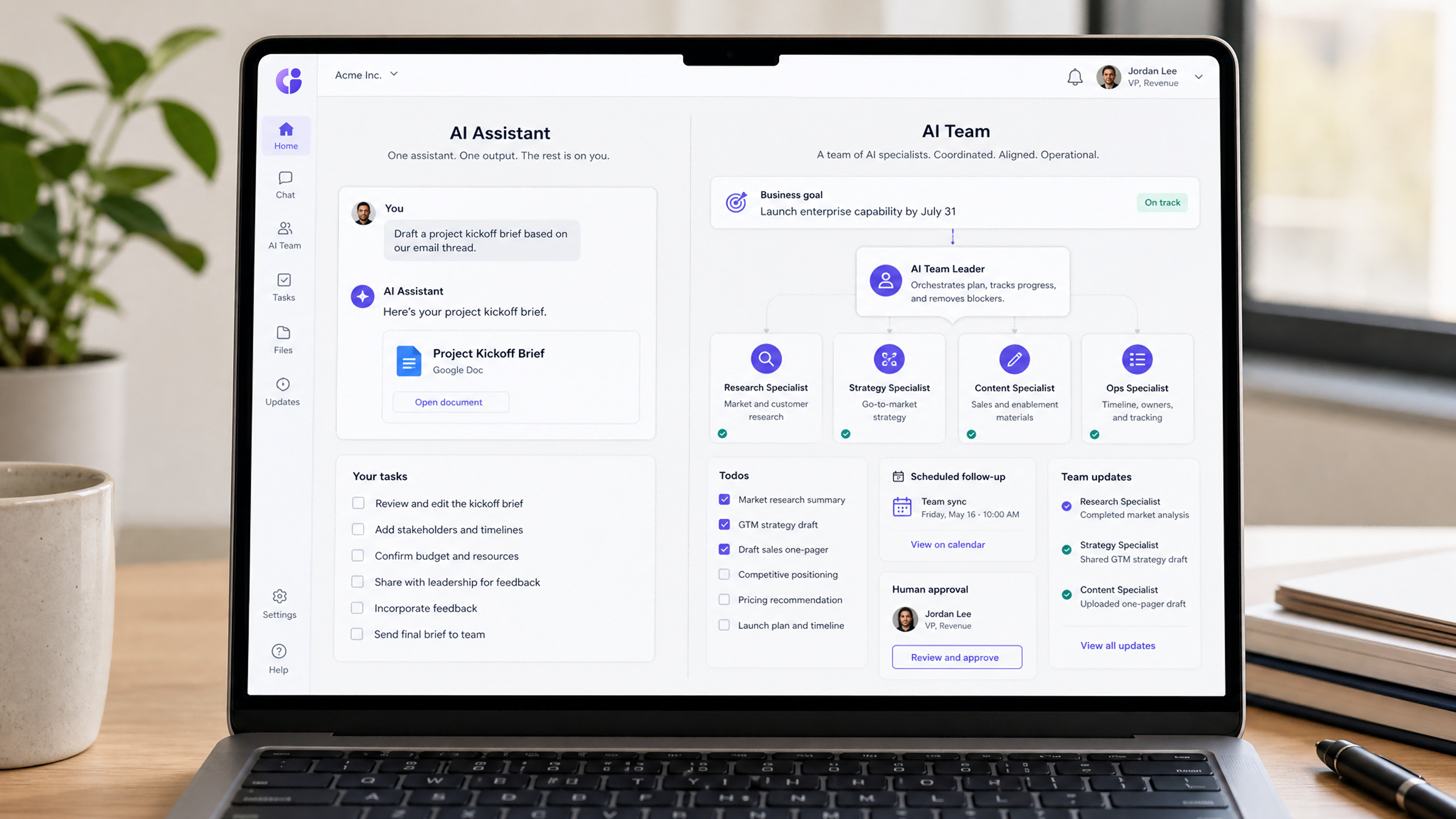
AI assistants changed individual productivity. They made it easier to draft, summarize, translate, brainstorm, and answer questions.
That was a major step forward. But it did not solve the deeper problem inside many companies: business work is coordinated work.
A company does not only need answers. It needs people or systems that can take a goal, split it into responsibilities, follow up over time, manage handoffs, and return important decisions to the right human.
That is why ClawTeams is building AI teams instead of another assistant.
The short answer
A single AI assistant helps a person complete tasks. An AI team helps a business coordinate work. ClawTeams is built around AI Team Leaders, specialist AI employees, shared workflow state, recurring execution, and human approval because real business outcomes require more than one conversation.
The assistant era helped people move faster
The first wave of generative AI made knowledge work feel lighter. A person could ask for a draft, a summary, a translation, or a list of ideas and receive something useful in seconds.
For individuals, this changed the speed of output.
But for teams, output speed is only one part of the job. The harder part is often deciding what should happen next, who owns it, what context matters, whether the result is good enough, and when a human needs to approve a decision.
An assistant can help with a step. A business needs an operating model.
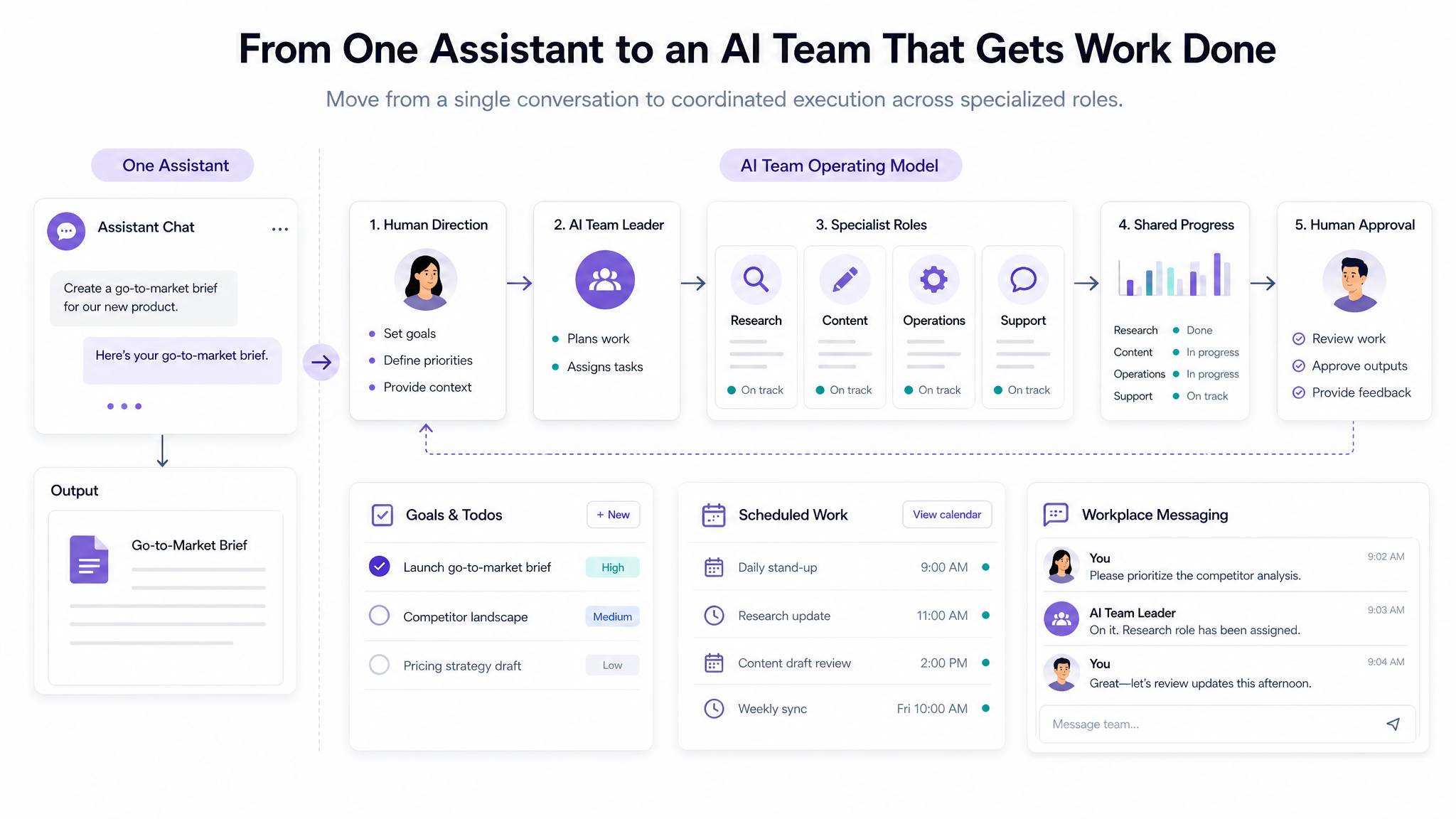
Why single-assistant workflows hit a ceiling
The single-assistant pattern has three common limits.
First, the human remains the project manager. The assistant can draft a plan, but the human still has to break it into tasks, brief the next role, track progress, and remember follow-up.
Second, the context becomes crowded. A long chat may contain strategy, data, content, customer feedback, decisions, and pending todos. When everything lives in one conversation, ownership becomes unclear.
Third, review becomes harder. If one assistant researches, plans, writes, analyzes, and recommends actions, it is difficult to separate which part of the work needs correction.
These limits are why the conversation is shifting from AI assistant vs AI agent to a bigger question: how should AI work be organized inside a company?
The same shift also appears in the agentic AI vs generative AI debate. Generative AI improved content creation. Agentic AI asks how AI can move work forward through planning, action, and feedback.
AI teams match the shape of business work
Business work usually has roles. A team lead coordinates. Specialists contribute. Tasks move through review. Meetings create rhythm. Decisions escalate when needed.
ClawTeams brings that organizational pattern into AI work.
An AI Team Leader can turn a business goal into workstreams. Specialist AI employees can focus on narrower responsibilities. Goals & Todos keep progress visible. Meetings and Scheduled Tasks create continuity. Workplace messaging keeps coordination close to where people already work. Human approval keeps authority in the right place.
This is not about pretending AI has become a full company by itself. It is about giving humans a better delegation layer.
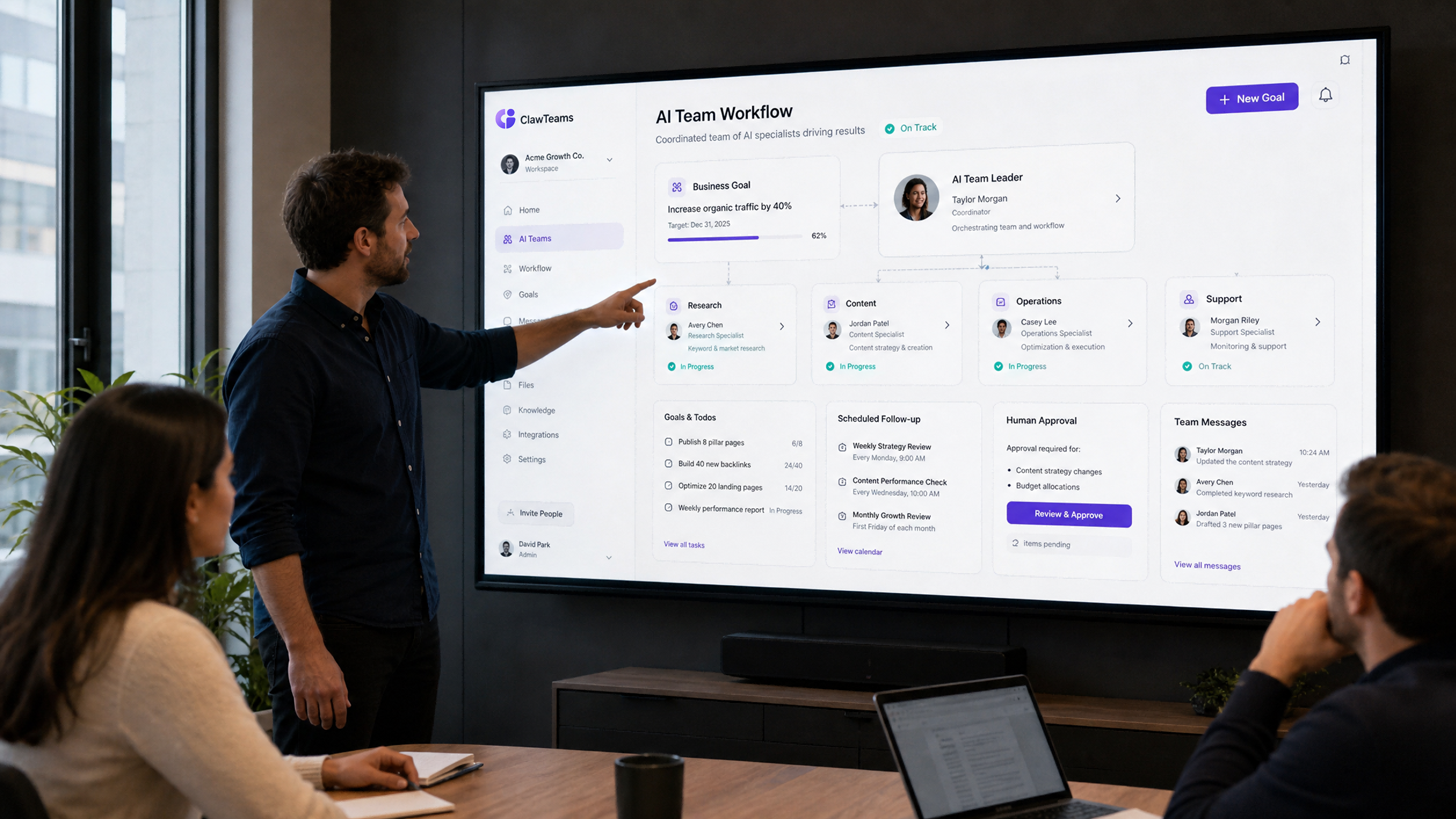
What we mean by an AI workforce
When we talk about AI workforces, we do not mean replacing every person with software. We mean a structured set of AI employees that can take on repeatable, well-scoped work under human direction.
A useful AI workforce has:
- Leadership: an AI Team Leader that coordinates work around a goal.
- Specialization: AI employees with clear responsibilities.
- Shared context: visible goals, tasks, decisions, and outputs.
- Operating rhythm: meetings, scheduled work, and follow-up.
- Control: human approval for important decisions and sensitive actions.
This model is especially valuable for lean teams. A founder, operator, or small department may not have enough people to cover every function, but still needs coordinated execution across research, content, operations, support, and analysis.
Why agentic AI needs company-level design
Agentic AI is often described as AI that can plan, use tools, and take action toward a goal. That is powerful, but action alone is not enough.
If the search question is what is agentic AI, the company answer is not only technical. Agentic AI becomes useful at work when it is organized through goals, roles, context, and approval.
For a company, agentic AI needs structure:
- Goals must be clear enough to guide work.
- Roles must be narrow enough to review.
- Tools must be connected with boundaries.
- Progress must be visible to humans.
- Decisions must return to people when judgment is required.
Without that structure, AI agents can become another layer of complexity. With it, they can become a practical way to scale execution.
ClawTeams is built for the second path.
What ClawTeams will not optimize for
Company philosophy matters because it shapes product decisions.
ClawTeams is not trying to make AI feel mysterious. We are not optimizing for black-box autonomy, "no human needed" promises, or demos that look impressive but are hard to operate.
Autonomous AI agents can be valuable in narrow scopes, but a company should not confuse autonomy with accountability.
We are optimizing for business delegation that can be understood and controlled:
- A human sets the goal.
- An AI Team Leader coordinates the work.
- Specialist AI employees execute defined responsibilities.
- The workflow keeps progress visible.
- Human approval protects important decisions.
This is a quieter promise than total automation. It is also more useful for real teams.
Where we believe work is going
The next useful step in business AI is not just more capable chat. It is AI that can participate in workflows with roles, rhythm, and accountability.
AI agents will become more capable. Agentic AI use cases will expand. But the companies that benefit most will still need product systems that make AI work legible and controllable.
That is the reason ClawTeams exists.
We believe the future of AI at work looks less like one assistant waiting for instructions and more like a coordinated team that can help a human move a business goal forward.
Conclusion
AI assistants made individuals faster. AI teams can make business execution more organized.
ClawTeams is building for that shift: from one conversation to coordinated work, from isolated outputs to shared progress, and from vague autonomy to human-controlled delegation.
The point is not to remove people from work. The point is to let people lead with clearer leverage.
Build your AI team with ClawTeams.
Related ClawTeams resources
- ClawTeams product overview: see how goals, specialist AI employees, meetings, scheduled tasks, and human approval fit together.
- Build your AI team: start from a business goal and assemble the specialist roles you need.
Frequently asked questions
What is the difference between AI teams and AI assistants?
An AI assistant usually helps one person complete a task in a conversation. An AI team coordinates multiple AI roles around a business goal, with shared context, task ownership, follow-up, and human approval.
Why does ClawTeams focus on AI teams?
ClawTeams focuses on AI teams because business work is coordinated work. Most outcomes require planning, delegation, specialist execution, review, and recurring follow-up rather than one isolated answer.
Are AI employees meant to replace human employees?
No. In ClawTeams, humans set goals, approve important decisions, and remain responsible for business judgment. AI employees help with repeatable, well-scoped work under human direction.
How is this related to agentic AI?
Agentic AI can plan and take action toward a goal. ClawTeams applies that idea through a team structure, where an AI Team Leader coordinates specialist AI employees inside visible and controllable workflows.
What is agentic AI in a company workflow?
Agentic AI is AI that can move toward a goal through planning, action, and feedback. In a company workflow, it needs roles, boundaries, context, and approval so that action remains accountable.
What kinds of teams can benefit from this model?
Lean companies, ecommerce operators, small departments, and founders can benefit when they need coordinated execution across multiple functions but do not want to manually manage every handoff.