
product
How ClawTeams Turns One Business Goal into an AI Team Workflow
A product guide to moving from a single prompt to coordinated AI employees, recurring execution, and human-controlled delivery.
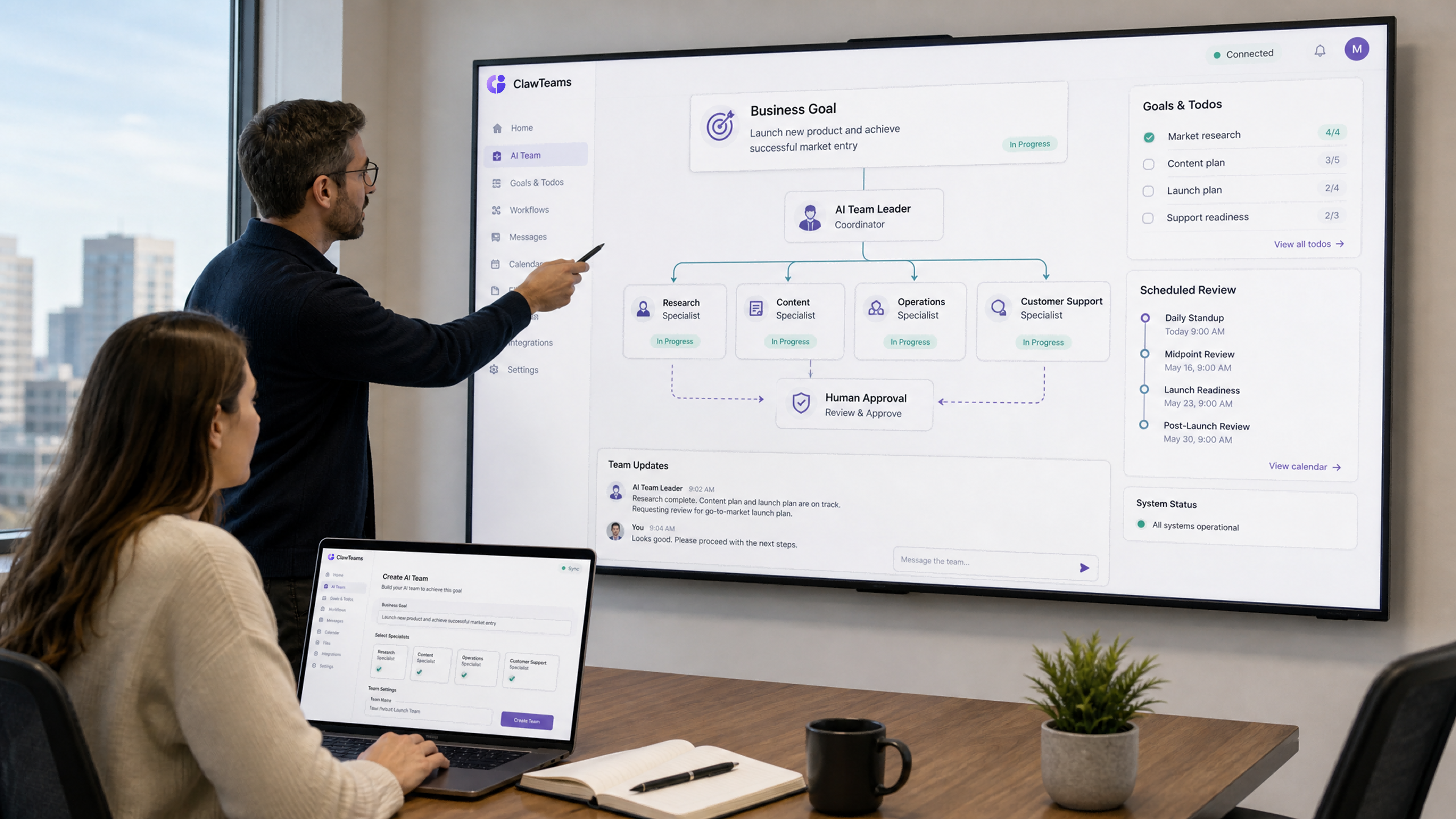
Most AI tools begin with a prompt. A person describes what they want, the model returns an answer, and the person decides what to do next.
That works for short tasks. It does not work as well when the goal turns into a real business process.
Improving retention, launching a product, preparing a campaign, monitoring customer issues, or coordinating a cross-border ecommerce workflow usually requires several roles. Someone needs to break down the goal, assign work, track dependencies, review outputs, and decide what should happen next.
That is why ClawTeams is designed around an AI team workflow rather than a single assistant conversation.
The short answer
ClawTeams starts from a business goal, uses an AI Team Leader to break that goal into workstreams, assigns specialist AI employees, keeps tasks visible through Goals & Todos, and supports recurring follow-up through meetings, scheduled tasks, workplace messaging, and human approval.
What is an AI team workflow?
An AI team workflow is a coordinated process where multiple AI roles work toward one business outcome. Instead of asking one general assistant to do everything, the work is organized across a Team Leader and specialist AI employees.
The goal is not to remove people from decision-making. The goal is to reduce the coordination burden that usually sits between the idea and the finished work.
A useful AI team workflow normally includes:
- A clear business goal: the outcome, constraints, timeline, and success criteria.
- A coordinating role: someone or something that breaks the goal into steps and keeps the work aligned.
- Specialist roles: focused AI employees for research, content, analysis, customer support, operations, or other business functions.
- Shared context: tasks, decisions, outputs, and updates that remain visible across the workflow.
- Recurring execution: meetings and scheduled tasks that help the work continue beyond one chat.
- Human control: approval points for important actions, direction changes, and final decisions.
This is the difference between creating an agent and operating a team.
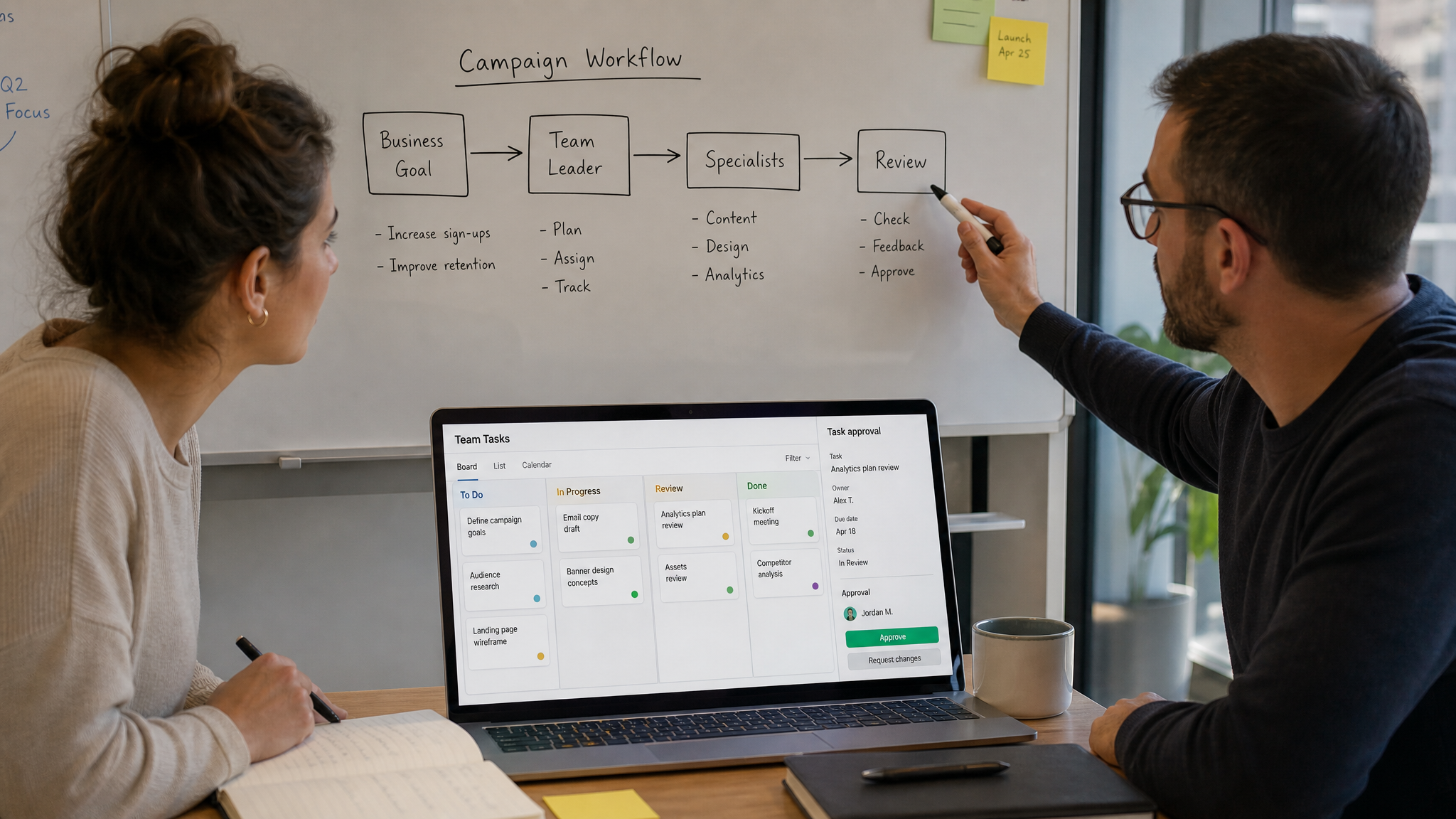
Why a single assistant is not enough for many business goals
A single AI assistant can produce useful drafts and answers. But when a goal crosses functions, the assistant often becomes another tool the human has to manage.
For example, a founder may ask for a plan to improve paid advertising performance. The assistant can write a plan. Then the founder still needs to turn the plan into tasks, ask for analysis, prepare copy, check landing pages, schedule reviews, compare results, and decide what to change next.
The assistant helped with thinking. It did not absorb the workflow.
This is where an AI agent platform needs more than model access and a chat box. It needs a product structure for delegation, review, and continuity.
The ClawTeams product model
ClawTeams treats business work as coordinated teamwork.
1. Start with a business goal
The workflow begins with the result the human wants. The goal can be strategic, operational, or recurring.
Examples include:
- Prepare a launch plan for a new product line.
- Improve customer reply quality for a support channel.
- Monitor a category and summarize weekly opportunities.
- Turn campaign feedback into content and task updates.
The human still owns intent, constraints, and judgment. ClawTeams helps turn that intent into a working process.
2. Let the AI Team Leader break down the work
The AI Team Leader translates the goal into workstreams. It identifies what needs to happen, which specialist roles should contribute, and where review or approval may be needed.
This matters because most failed AI workflows do not fail at writing. They fail at handoff, context, priority, and follow-through.
3. Assign specialist AI employees
Specialist AI employees can focus on narrower responsibilities. A research role can gather and summarize information. A content role can draft messaging. A data-oriented role can help organize findings. A customer-facing role can support replies within defined boundaries.
Specialization makes review easier. It also prevents one broad assistant from mixing too many responsibilities into one thread.
4. Keep Goals & Todos visible
Business work needs state. People need to know what the goal is, what has been done, what is blocked, and what is waiting for a decision.
Goals & Todos give the workflow an operating surface. They help the team remember context, keep next steps visible, and reduce repeated briefing.
5. Use meetings and scheduled tasks for recurring work
Many business outcomes require rhythm. A weekly review, a daily scan, or a scheduled follow-up is often more valuable than a one-time answer.
Meetings and Scheduled Tasks help ClawTeams support ongoing workflows. They create a structure for checking progress, updating priorities, and continuing work at the right time.
6. Bring updates back through workplace messaging
Teams already live in messaging tools. A practical AI team workflow should not force every update into a separate dashboard.
ClawTeams is built for workplace messaging patterns: delegation, status updates, task discussion, and review can happen where work is already coordinated.
7. Keep important actions under human approval
An AI team should not become a black box. Humans should be able to review important outputs, change direction, pause execution, and approve sensitive actions.
For business use, control is not a nice-to-have feature. It is part of the product.
This is also why ClawTeams avoids treating autonomous AI agents as the default answer for every business problem. The product goal is useful delegation with visible control, not uncontrolled automation.
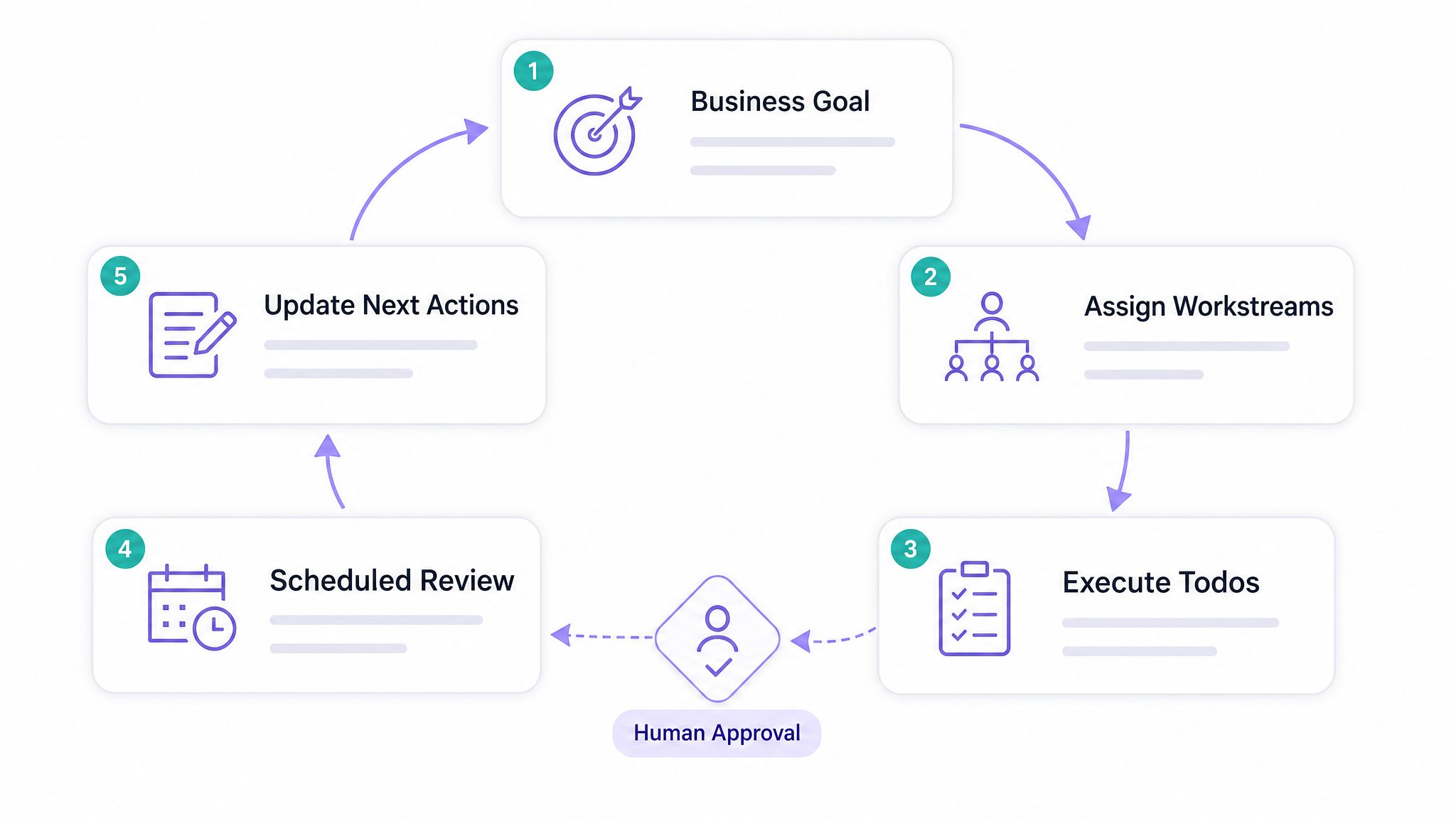
A practical AI team workflow example
Imagine a lean ecommerce team with this goal:
Improve repeat purchases for a skincare bundle without relying on a deeper discount.
In a single-assistant workflow, the output might be a retention strategy document.
In ClawTeams, the goal can become a coordinated workflow:
- The AI Team Leader breaks the goal into research, customer insight, content, operations, and review workstreams.
- A research AI employee summarizes customer objections, product positioning, and competitor messaging.
- A content AI employee drafts email, landing page, and post-purchase message ideas.
- An operations AI employee turns the plan into todos, timelines, and follow-up tasks.
- A meeting or scheduled task checks results and prepares the next adjustment.
- A human reviewer approves the final messaging and business decisions.
The value is not just that AI writes faster. The value is that the workflow keeps moving with less manual coordination.
When this product approach is useful
An AI team workflow is especially useful when the work has several of these traits:
- The goal involves more than one function.
- The task needs follow-up after the first output.
- Different roles need different context and quality standards.
- The team wants visibility into what is happening.
- The business needs approval before important actions.
- The work repeats weekly, daily, or around recurring events.
For one-off drafting, a normal assistant may be enough. For business execution, the team model is often a better fit.
What to look for in an AI agent builder
If you are evaluating an AI agent builder or AI agent platform for business teams, look beyond whether it can create one agent.
If your starting question is how to build an AI agent, the better business question is often how to build a workflow that can coordinate several agents safely.
Ask whether it supports:
- Goal-based planning instead of only prompt-based output.
- Role separation for specialist work.
- Shared context across tasks and people.
- Recurring workflows, meetings, or scheduled actions.
- Approval points for important decisions.
- Clear visibility into progress and next steps.
- A path from chat to real operational follow-through.
These are the product capabilities that turn AI agents examples into something a team can actually use.
Conclusion
The future of business AI is not only a better assistant. It is a more organized way to delegate work.
ClawTeams is built around that idea: start from a goal, let an AI Team Leader coordinate the work, assign specialist AI employees, keep the process visible, and return important decisions to the human.
For teams exploring agentic AI use cases, this operating model is often the missing layer between a good answer and real execution.
Build your AI team with ClawTeams.
Related ClawTeams resources
- ClawTeams product overview: see how goals, specialist AI employees, meetings, scheduled tasks, and human approval fit together.
- Build your AI team: start from a business goal and assemble the specialist roles you need.
Frequently asked questions
What is an AI team workflow?
An AI team workflow is a coordinated process where an AI Team Leader and specialist AI employees work toward a business goal. It includes task breakdown, role assignment, shared context, follow-up, and human approval.
How is this different from an AI agent builder?
An AI agent builder usually focuses on creating individual agents. ClawTeams focuses on coordinating multiple AI employees around one goal, so the workflow includes leadership, delegation, recurring tasks, and review.
Can ClawTeams replace a human manager?
No. ClawTeams is designed to reduce coordination overhead, not remove human judgment. Humans define the goal, set constraints, approve important decisions, and adjust direction.
What kinds of business work fit an AI team workflow?
Useful scenarios include ecommerce operations, campaign planning, research workflows, customer support improvement, recurring reporting, product launch preparation, and cross-functional follow-up.
Why does human approval matter?
Human approval keeps important actions controlled. It helps teams use AI for execution while preserving business accountability, brand judgment, and risk management.