
guides
Agentic AI vs Generative AI: What Changes When AI Starts Taking Action?
A practical comparison of content generation, goal-driven action, autonomy levels, and business control.
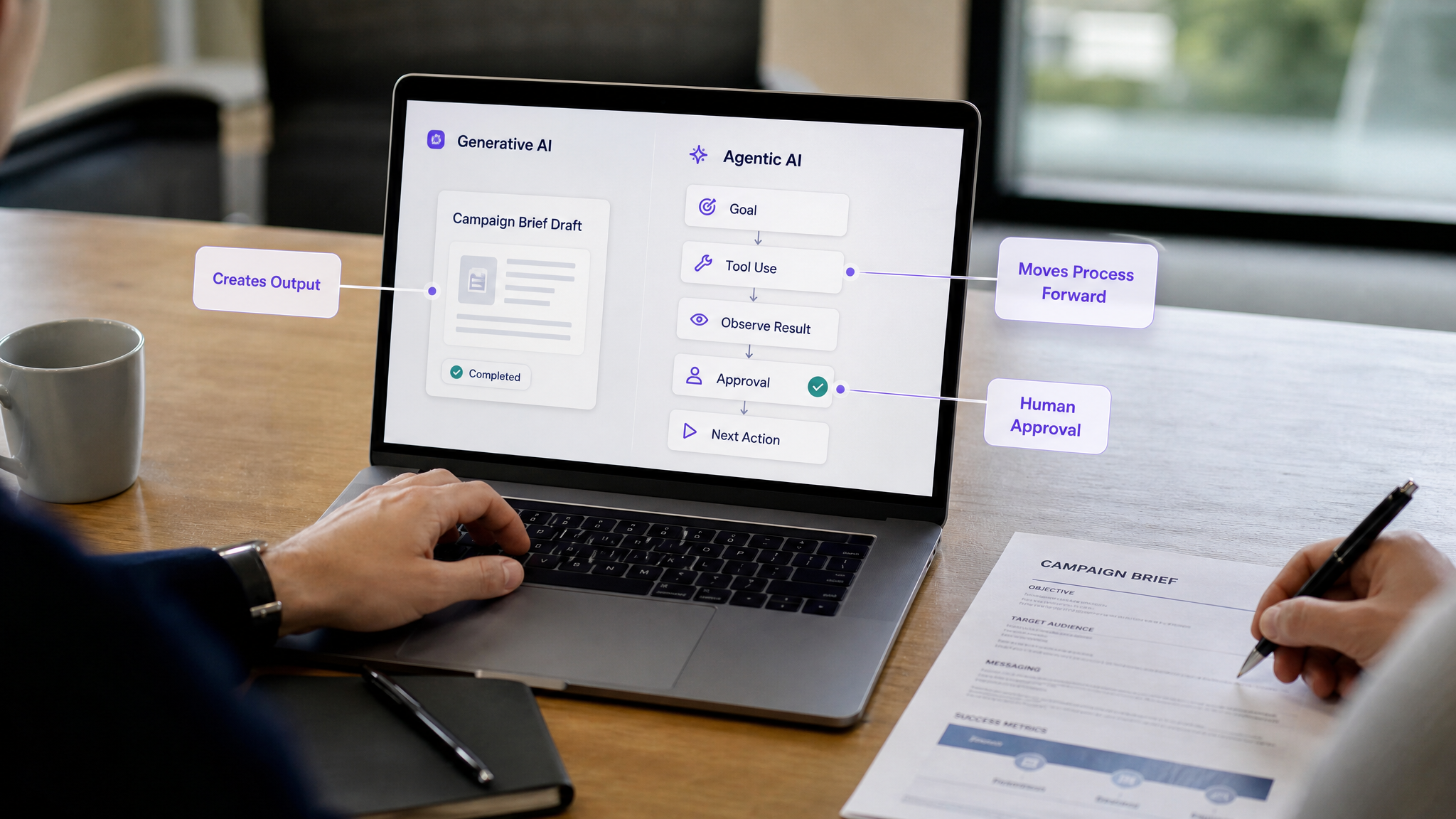
Generative AI changed how quickly people can create. It can draft a campaign, summarize a report, generate an image, write code, or answer a question in seconds.
Agentic AI changes a different part of work. Instead of stopping after producing an answer, it can pursue a goal through multiple steps: choosing an action, using an approved tool, observing the result, and deciding what should happen next.
That is the practical center of the agentic AI vs generative AI comparison. One primarily creates outputs. The other organizes actions around an outcome.
The short answer
Generative AI produces content from an input. Agentic AI uses models, context, tools, state, and feedback loops to move a defined process forward. Most agentic systems still use generative AI, but they add planning, action, and control around it.
What is generative AI?
Generative AI creates new content based on patterns learned from data and the context provided by a user. Its outputs can include text, images, audio, video, software code, and structured data.
For business teams, it is useful for tasks such as:
- Drafting copy, reports, and product descriptions.
- Summarizing documents or customer conversations.
- Producing concepts and localized variants.
- Generating code, formulas, or first-pass analysis.
The usual interaction is prompt-and-response. The user requests an output, evaluates it, and decides what to do next.
What is agentic AI?
Agentic AI is designed to pursue a goal through action. An agent can interpret an objective, select a next step, use an approved tool, retain workflow state, and continue until it reaches a stopping condition or needs human input.
A business-ready agentic system normally includes:
- A measurable goal and a defined role.
- Access to relevant context and approved tools.
- State that records progress across steps.
- Rules for evaluating results and choosing the next action.
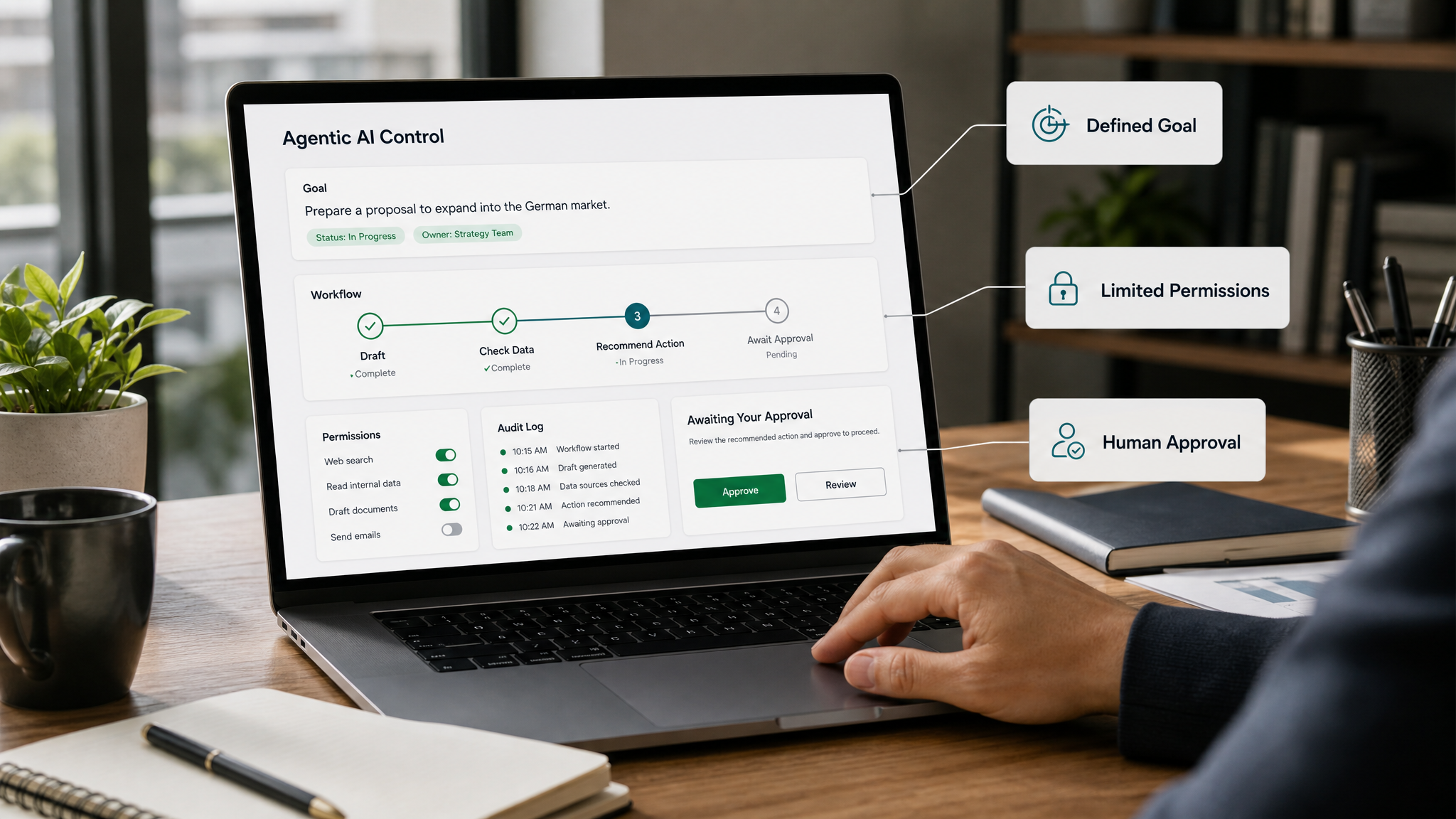
- Permissions, logs, approval points, and stopping conditions.
Agentic AI does not imply unrestricted autonomy. Reliable agents operate within boundaries and return consequential decisions to a person.
Generative AI vs agentic AI in one table
| Dimension | Generative AI | Agentic AI |
|---|---|---|
| Primary purpose | Create an output | Pursue an outcome |
| Typical interaction | Prompt and response | Multi-step process |
| Tool use | Optional | Often central to the workflow |
| Planning | Usually provided by the user | Can plan within a defined scope |
| State | Often limited to the interaction | Tracks progress across steps |
| Response to results | Waits for another prompt | Can observe and adapt |
| Human role | Requests and reviews content | Defines goals, permissions, and approvals |
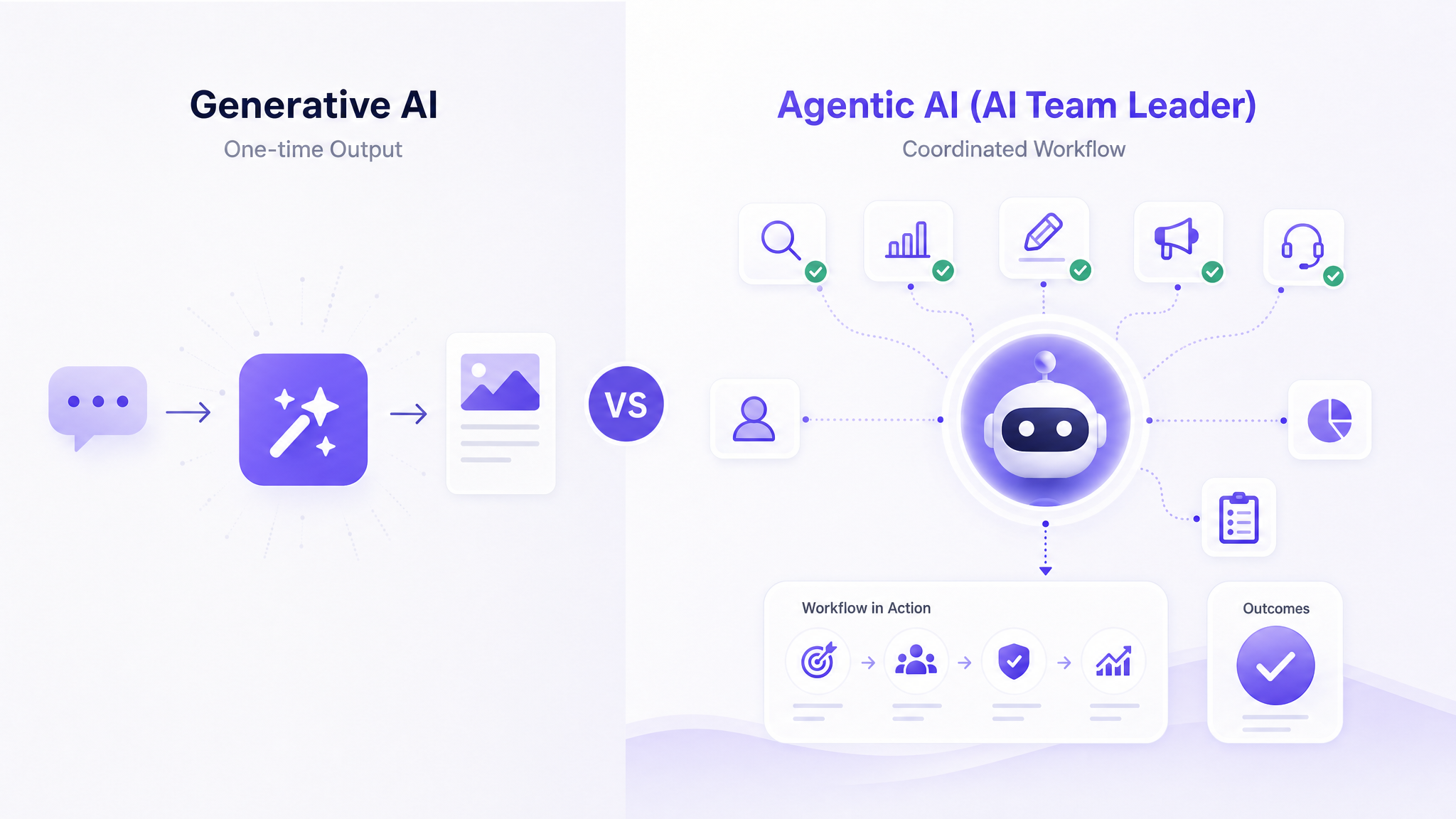
The two categories are not competitors. Agentic systems often use generative models for reasoning, language, and content creation. The agentic layer adds continuity and action.
The autonomy spectrum
Not every agentic system has the same degree of autonomy. It is more useful to think in levels:
- Generative assistant: produces an answer and waits.
- Tool-using assistant: can call a tool when the user requests it.
- Workflow agent: follows a defined sequence and maintains state.
- Goal-directed agent: chooses among approved actions based on results.
- Autonomous AI agents: operate for longer periods with broader decision authority and fewer checkpoints.
Autonomous AI agents attract attention, but maximum autonomy is rarely the best default for business work. As authority increases, so do the requirements for observability, permissions, testing, and human intervention.
The right question is not “How autonomous can this agent be?” It is “How much autonomy does this task safely require?”
Practical types of AI agents
The types of AI agents that matter most to business teams are better defined by their operating responsibility than by technical labels.
Research agents
Research agents gather information from approved sources, compare evidence, and produce a structured result. They are useful when the process involves several searches, source checks, and synthesis steps.
Workflow agents
Workflow agents move a repeatable process forward. They may collect inputs, update a system, route an item for approval, and record completion.
Monitoring agents
Monitoring agents watch for changes in metrics, inventory, customer feedback, or operational status. They summarize what changed and raise exceptions that require attention.
Coordination agents
Coordination agents manage dependencies across roles or workstreams. Their value is not generating every output themselves, but ensuring that the right work happens in the right order.
Agentic AI examples that show the difference
The clearest agentic AI examples are processes in which generation is only one step.
Many searches for AI agents examples focus on demos, but the useful business examples are workflows with context, action, feedback, and control.
Customer service escalation
Generative AI drafts a response. An agentic workflow retrieves approved customer context, classifies the request, drafts the reply, and escalates refunds or sensitive cases to a person.
Campaign monitoring
Generative AI writes campaign content. An agent monitors approved performance data, detects a threshold change, prepares an explanation, and requests approval before altering the plan.
Operations exception handling
Generative AI summarizes an issue. An agentic process checks the relevant system, identifies the blocked dependency, assigns the next action, and records the resolution.
Recurring analysis
Generative AI explains a dataset. An agentic workflow gathers the approved inputs on schedule, runs the analysis, compares it with the previous period, and raises decisions for review.
In each example, the generated content matters. The larger value comes from connecting that content to a controlled process.
Which approach should you use?
Use generative AI when the task ends after one output, no external action is required, and a person will manage every next step. Rewriting a paragraph, summarizing a document, producing ideas, or drafting an asset usually fits this model.
Use agentic AI when:
- The goal requires multiple steps.
- Progress must persist across time.
- The system needs approved tool access.
- A result should trigger a next action.
- Exceptions can be routed to a person.
- Scheduled monitoring or recurring execution is required.
Adding tools, memory, and planning also adds complexity. Use the simplest model that can reliably complete the work.
Risks that appear when AI can act
The risk profile changes when AI moves from creating content to performing actions.
- Permission risk: the agent can access more than its role requires.
- Compounding errors: one weak decision affects later steps.
- Hidden state: the operator cannot see why the workflow changed direction.
- Unclear ownership: people assume the agent is responsible for a decision that still requires human judgment.
- Runaway execution: recurring work continues without a useful review or stopping condition.
Good agentic design uses narrow roles, limited permissions, visible logs, approval gates, safe failure behavior, and clear stopping conditions.
Where ClawTeams fits
ClawTeams is designed for business work that needs more than one output or one role. The product adds a team structure around agentic capabilities: a human sets the goal, an AI Team Leader coordinates execution, and specialist AI employees handle defined workstreams.
Goals, todos, scheduled work, meetings, workplace messaging, and human approval make execution visible and controllable. The emphasis is not unrestricted autonomy. It is reliable delegation across a coordinated AI team.
You can explore how ClawTeams structures coordinated AI teams on the ClawTeams product page.
The difference appears after the output
Generative AI answers, creates, and explains. Agentic AI can carry that capability into a sequence of actions.
The generative AI vs agentic AI decision therefore depends on what happens after the first output. If a person will take every next step, generation may be enough. If the process must continue across tools, time, or roles, an agentic approach may be more useful.
For business use, autonomy should remain proportional to the task. Give agents enough authority to remove repetitive coordination, while keeping goals, permissions, exceptions, and important decisions under human control.
Build your AI team with ClawTeams.
Related ClawTeams resources
Continue with these ClawTeams resources if you want to move from the comparison to product structure or workflow examples:
- ClawTeams product overview: learn how goals, specialist AI employees, meetings, scheduled work, and human approval fit together.
- Build your AI team: start from a business goal and define the specialist roles your workflow needs.
Frequently asked questions
What is the main difference between agentic AI and generative AI?
Generative AI creates outputs from a prompt, such as text, images, code, summaries, or ideas. Agentic AI uses models, context, tools, state, and feedback loops to move a defined process forward.
Is agentic AI the same as autonomous AI agents?
No. Autonomous AI agents are one possible form of agentic AI, but agentic systems can also operate with narrow permissions, visible logs, approval gates, stopping conditions, and frequent human checkpoints.
When should a business use agentic AI?
A business should consider agentic AI when work requires multiple steps, approved tool access, persistent progress, scheduled monitoring, exception handling, or a next action based on results.
What types of AI agents are useful for business teams?
Useful business agents include research agents, workflow agents, monitoring agents, and coordination agents. The best type depends on whether the task is about gathering information, moving a process forward, watching for changes, or managing dependencies.
How does ClawTeams use agentic AI?
ClawTeams uses agentic capabilities inside a controlled team structure. A human sets the goal, an AI Team Leader coordinates execution, and specialist AI employees handle defined workstreams with shared context, recurring work, and human oversight.