
guides
AI Agent Builder Guide: Build an AI Team, Not Just Another Assistant
How to move from a single AI assistant to a coordinated team led by an AI Team Leader.
Most AI agent builder tools begin with a simple promise: describe a task, connect a few tools, and create an agent that can do the work. That is useful. It is also only the first layer of what a business actually needs.
Business work rarely fits inside one prompt or one role. A launch spans research, operations, content, paid media, customer service, and analysis. A retention program runs for weeks, adapts to each result, and creates new decisions for different stakeholders. Even a capable agent can become another thing the operator has to brief, monitor, and connect to the next step.
The more important question is therefore not just “Which AI agent builder can create an agent?” It is “Which builder can turn a goal into a coordinated team that keeps work moving?”
The short answer
Choose an AI agent builder that supports clear roles, shared context, delegation, recurring execution, review, and human control. For cross-functional business work, the strongest operating model is an AI team coordinated by a Team Leader rather than one all-purpose assistant.
What is an AI agent builder?
An AI agent builder is a product or framework for creating software agents that can understand a goal, use context, call tools, make decisions within a defined scope, and take action. Depending on the platform, an agent may read a database, browse the web, update a CRM, draft a response, trigger a workflow, or ask a person to approve a high-risk step.
The category ranges from developer frameworks to no-code workflow tools and business-facing agent platforms. The interface changes, but every builder combines some version of the same five ingredients:
- Instructions: the role, objective, boundaries, and expected output.
- Context: the business information the agent needs to make a useful decision.
- Tools: the systems the agent can read from or act on.
- Memory: the useful state that should survive beyond one interaction.
- Control: the approvals, permissions, logs, and limits that keep the work accountable.
A basic builder can combine those ingredients into one assistant. A business-grade builder must also account for what happens when the work requires several roles, dependencies, deadlines, and repeated follow-up.
Agentic AI vs generative AI
People often compare agentic AI vs generative AI because both can produce intelligent-looking outputs. The practical difference is what happens after the output is created.
Generative AI creates. It writes copy, summarizes a document, generates an image, produces code, or drafts an answer. Agentic AI acts toward a goal. It can determine a next step, use a tool, observe the result, update its plan, and continue until it reaches a stopping condition or needs human input.
A useful business agent often includes both. A Content Agent may use generative AI to draft a campaign, while its agentic behavior gathers customer insights, checks the current goal, requests performance data, creates the draft, routes it for review, and records the next action.
| Model | Primary job | Typical output | Business limitation |
|---|---|---|---|
| Generative AI | Create content from a prompt | Copy, summaries, images, code | Usually stops after producing the response |
| Single AI agent | Pursue one role or workflow | Completed task or tool action | Still needs an operator to coordinate cross-role work |
| AI team coordinated by a Team Leader | Coordinate specialists around one goal | Ongoing, reviewed business execution | Requires clear ownership, controls, and an operating rhythm |
Why one powerful agent still creates a coordination problem
The appeal of one general-purpose agent is obvious: one interface, one conversation, and no team design. The problem appears when the task becomes a process.
Imagine asking an agent to improve repeat purchases for an ecommerce store. It can propose a plan. But execution immediately branches. Someone must analyze order data, summarize customer objections, create retention messages, plan channel experiments, update the timeline, and review the results next week. If one agent handles everything, its context becomes broad, responsibilities blur, and review becomes harder.
If several independent agents handle the work, the operator becomes the project manager. The operator repeats context, resolves conflicting outputs, tracks dependencies, and remembers what should happen next. The agents save production time but leave the coordination load untouched.
This is the gap between agent creation and the broader AI agent platform capabilities businesses need for orchestration.
How a Team Leader coordinates an AI team
ClawTeams approaches the problem as an organization, not a collection of prompts. The human sets the direction. An AI Team Leader translates that direction into work. Specialist AI employees execute within clear roles. Goals, todos, meetings, and scheduled tasks keep the system moving over time.
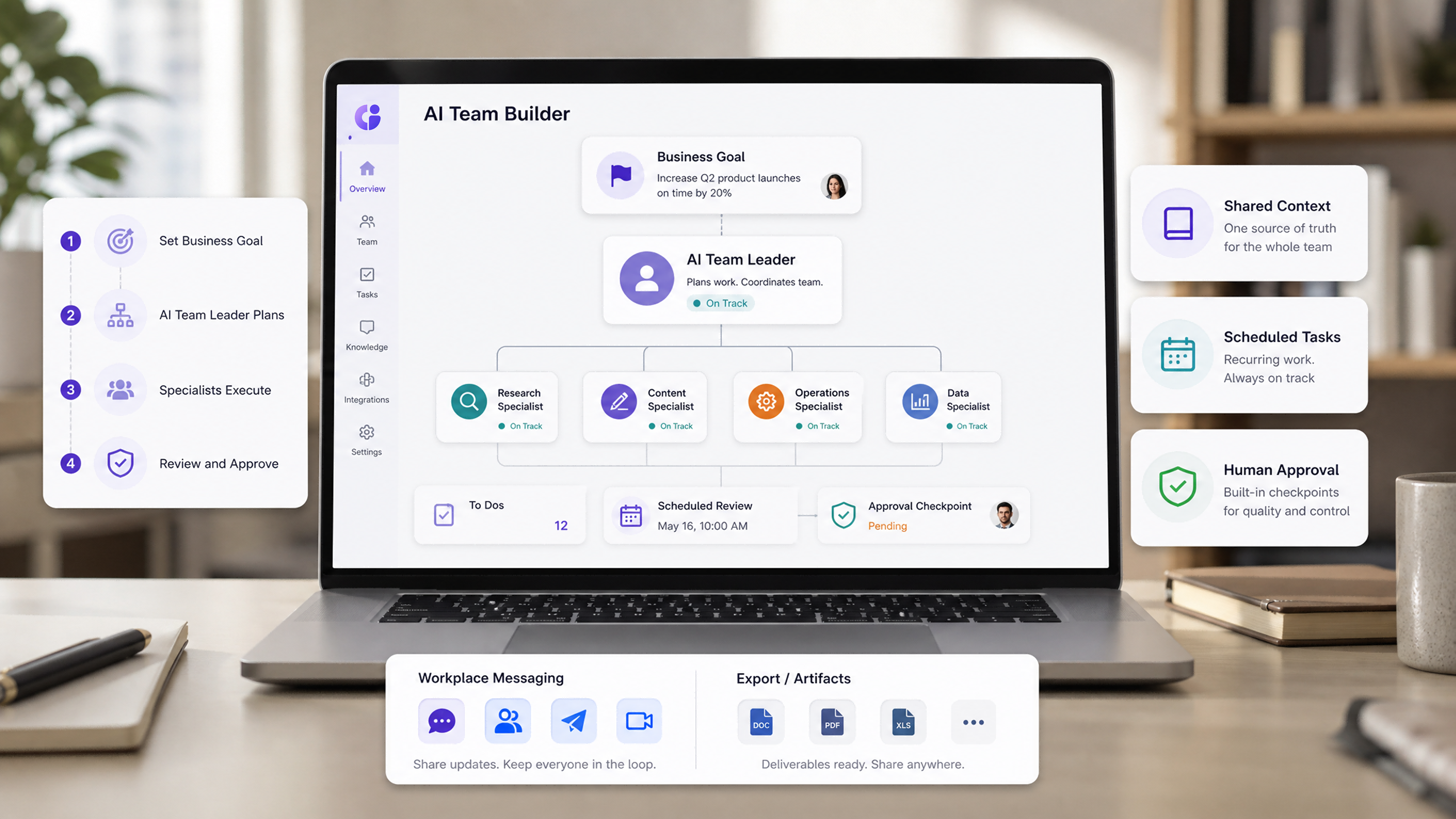
- The human defines the outcome. Start with a business goal, constraints, timing, and the decisions that must remain human-owned.
- The AI Team Leader designs the work. It decomposes the goal into workstreams, assigns ownership, identifies dependencies, and creates an initial operating plan.
- Specialist agents execute. Research, content, customer service, media, operations, and data agents work within narrower responsibilities and quality standards.
- The team shares operational context. Goals, todos, prior decisions, meetings, and outputs remain connected so each role does not start from zero.
- Recurring work closes the loop. Scheduled tasks and meetings review progress, surface blockers, update priorities, and create the next set of actions.
- The human stays in control. Important actions can return for review, and the operator can change direction, pause work, or redefine the goal.
The result is not an autonomous company running without people. It is a more disciplined delegation layer: the human owns intent and judgment, while the AI team absorbs much of the coordination and execution overhead.
A practical AI team workflow
Consider a lean ecommerce company with this goal:
Business goal
Increase the 60-day repeat purchase rate for a skincare bundle without offering deeper discounts.
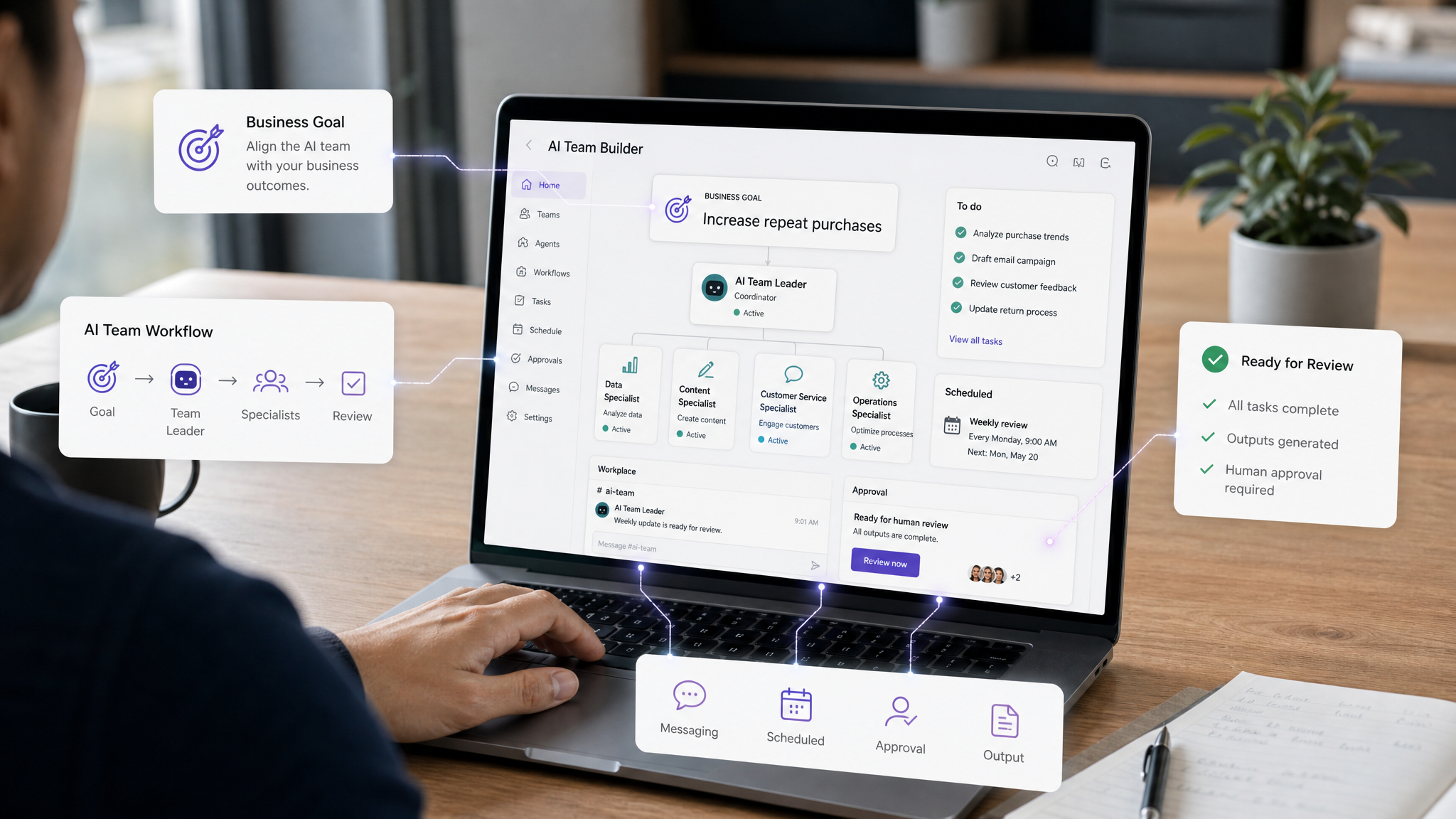
A single agent might return a good retention plan. A team coordinated by a Team Leader can turn the plan into an operating loop:
- The AI Team Leader defines the measurement window and workstreams, identifies decision points, and sets the weekly review cadence.
- The Data Analysis Agent segments customers, identifies drop-off patterns, and creates a baseline.
- The Customer Service Agent groups recurring objections and product questions from conversations.
- The Content Agent drafts education, replenishment, and cross-sell messages using those insights.
- The Paid Media Agent proposes retargeting audiences and tests that do not depend on deeper discounts.
- The Operations Agent tracks inventory, launch timing, and channel readiness.
- The Team Leader consolidates the work, flags conflicts, and escalates decisions that require human approval.
- A recurring review compares results against the goal and updates the next week's todos.
This is one of the most useful AI agent examples because it shows where value comes from. Each specialist contributes a bounded capability, but the business outcome depends on how the roles share context and respond to each other's work.
Seven things to evaluate in an AI agent builder
Do not choose a platform based only on the fastest demo. A one-minute agent setup can still create months of maintenance if the operating model is unclear. Evaluate the system against the way your team actually works.
- Role clarity: Can every agent have a defined responsibility, boundary, and quality standard?
- Shared context: Can agents work from the same goals, decisions, todos, and business knowledge?
- Delegation: Can a coordinating role break down work and assign it to the right specialist?
- Recurring execution: Can the system run scheduled work and reviews without a fresh prompt every time?
- Workplace access: Can people delegate and receive updates through the communication channels they already use?
- Observability: Can an operator see what happened, why it happened, and what is waiting for review?
- Human control: Can people approve sensitive actions, change direction, pause execution, and retain final authority?
ClawTeams is designed around these operating requirements. Users begin with a business goal, assemble the expert roles they need, connect the team to channels such as Slack, Telegram, Lark, WeCom, or DingTalk, and keep work moving through meetings, scheduled tasks, and goal-oriented todos.
Where OpenClaw fits
OpenClaw is part of the runtime foundation behind ClawTeams. It contributes agent execution capabilities, but it is not the product definition.
Developers may first encounter this foundation through OpenClaw GitHub, then explore OpenClaw skills or an individual OpenClaw skill for specific runtime capabilities. Those resources explain how agents can act; ClawTeams focuses on how a business organizes those capabilities into a coordinated team.
ClawTeams adds the business-facing team layer: guided team creation, an AI Team Leader, specialist employee roles, shared goals and todos, recurring operating rhythms, workplace collaboration, visibility, and human oversight. The distinction matters because a runtime answers how an agent can act; ClawTeams answers how a business can organize agents into a team that owns an outcome.
When a personal assistant is enough
Not every task needs an AI team. A personal assistant is usually the right choice when the work belongs to one person, has limited dependencies, and can be completed in one conversation or one narrow workflow. Inbox triage, calendar help, personal research, and local file tasks are good examples.
An AI team led by a Team Leader becomes useful when:
- Several specialist roles contribute to the same outcome.
- Work continues across days or weeks.
- Outputs from one role become inputs for another.
- Progress, blockers, and decisions need to remain visible.
- Recurring reviews should create the next set of actions.
- A human needs to retain approval over consequential steps.
The dividing line is simple: if the main problem is producing an answer, use an assistant. If the main problem is coordinating execution around a goal, build a team.
Build for the work after the first prompt
The first generation of AI tools made creation faster. The next step is making execution more coherent.
A capable AI agent can complete a task. An AI team led by a Team Leader can keep a business goal connected to the people, roles, decisions, and recurring work required to achieve it. That is the standard an AI agent builder should now meet.
With ClawTeams, the human sets the direction, the AI Team Leader coordinates execution, and specialist AI employees move each workstream forward. You do not just get another assistant. You get a team built around the outcome.
Build your AI team with ClawTeams.
Related ClawTeams resources
Continue with these ClawTeams resources if you want to compare concepts, see the product model, or look at a concrete workflow:
- ClawTeams product overview: see how goals, specialist AI employees, meetings, scheduled tasks, and human approval fit together.
- Build your AI team: start from a business goal and assemble the specialist roles you need.
Frequently asked questions
What is an AI agent builder?
An AI agent builder is a platform or framework for creating agents that can understand goals, use context and tools, make bounded decisions, and complete work with varying levels of autonomy.
Is ClawTeams an AI agent builder?
Yes. ClawTeams lets business users create specialist AI employees and organize them into a coordinated AI team. The product emphasizes goals, roles, todos, recurring work, workplace messaging, and human oversight rather than only single-agent setup.
What is the difference between an AI agent and an AI team?
An AI agent performs one role or workflow. An AI team coordinates multiple specialist agents around one business goal, with shared context, dependencies, review, and an operating rhythm.
When is an AI team better than a personal assistant?
An AI team is more useful when work involves multiple roles, recurring follow-up, handoffs between workstreams, visible progress tracking, and decisions that should return to a person for approval.
How does OpenClaw relate to ClawTeams?
OpenClaw is part of the runtime foundation behind ClawTeams. ClawTeams adds the business-facing layer for team creation, AI leadership, specialist roles, goals and todos, recurring execution, collaboration channels, visibility, and human control.